Evidence checked by Smile Insights Editorial Team. Last reviewed 10 September 2026
Cheap Dental Implants UK: 5 Ways to Assess Your Options
Looking for affordable dental implants? Compare five UK options, NHS limits, teaching clinics and payment plans before choosing treatment within your budget.
Editorial update checked against NHS patient information, NHSBSA help-with-costs guidance and GDC treatment-plan standards. No individual clinical assessment, dentist review or nationwide price survey is claimed.
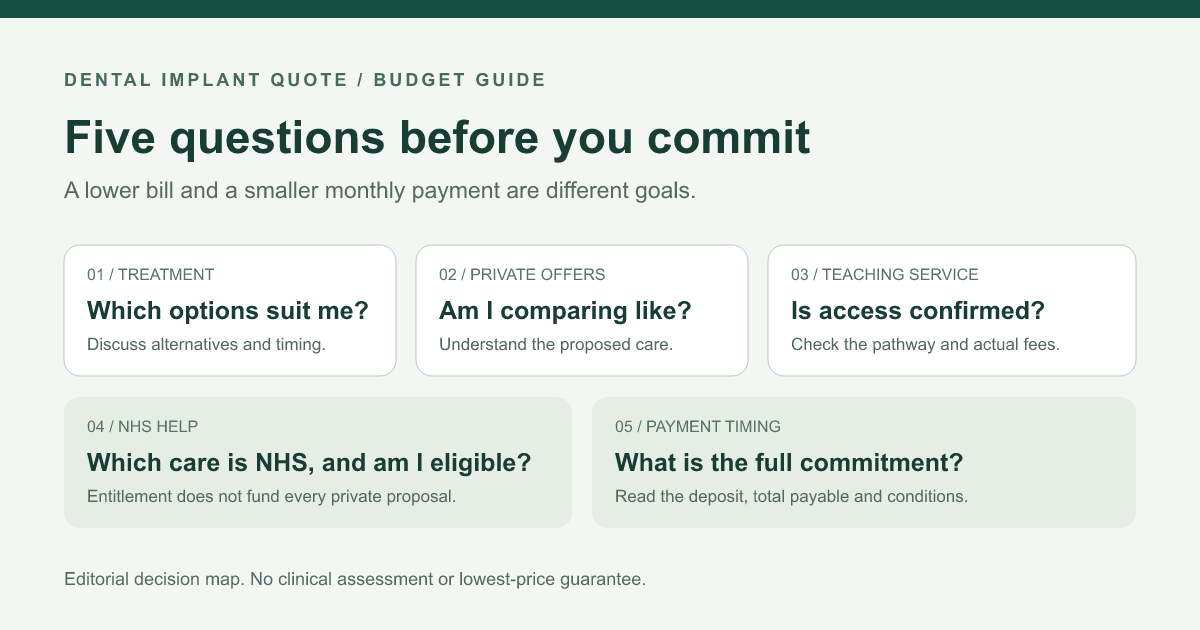
Cheap dental implants in the UK cannot be identified by the lowest advertised number alone. If your treatment quote is beyond your budget, there are five useful avenues to investigate: suitable treatment alternatives, comparable private offers, a verified teaching service, help with eligible NHS care, and a payment arrangement you can afford. They solve different problems. None guarantees the cheapest implant or a successful clinical outcome.
The first distinction is between reducing the treatment bill and spreading that bill over time. The second is between making implant treatment affordable and choosing a different way to replace a missing tooth. The NHS dental treatment overview describes implants alongside bridges and dentures, and says NHS implants are only sometimes available in particular circumstances. An assessment is needed to establish which choices apply to you.
Dental Implant Quote is a comparison service, not your treating clinic. This guide helps you organise a budget discussion without treating an advertisement, a credit offer or a teaching-course website as a clinical recommendation. It contains no nationwide cheapest-clinic ranking and no assumed discount for university treatment.
Contents
- What counts as an affordable option?
- 1. Discuss alternatives and the timing of treatment
- 2. Compare private options for the same clinical goal
- 3. Check a teaching service before counting on a saving
- 4. Separate NHS help from a private implant budget
- 5. Compare payment arrangements without disguising the cost
- A fictional budget decision
- Your next step
- Frequently asked questions
What counts as an affordable option?
An affordable option has an understood clinical purpose, a reasonably clear financial commitment and a payment timetable that fits your circumstances. A low starting price answers only part of that question. You also need to know whether you are comparing the same treatment and what remains undecided.
An implant is the support placed in the jaw; the visible replacement may be a crown, bridge or denture. An abutment connects an implant to the restoration it supports. A price for one component cannot automatically be compared with a complete replacement tooth, and a single-tooth offer cannot establish the price of replacing several teeth.
Use the five routes below as a decision map. The order is practical, not a ranking of providers, treatments or safety. More than one route may be relevant, but combining them does not remove the need for a coherent treatment plan.
| Avenue to investigate | Budget question it answers | Evidence to obtain before relying on it |
|---|---|---|
| Alternatives or different timing | Is another clinically suitable plan possible? | Your dentist's explanation of options and consequences |
| Comparable private offers | Is the proposed treatment priced differently elsewhere? | Written plans describing comparable scope |
| Teaching service | Is a relevant patient pathway actually available? | Current acceptance criteria, fees and responsibility for care |
| Help with NHS costs | Can eligible NHS care receive financial help? | Confirmation of NHS status and your entitlement |
| Payment arrangement | Can the agreed bill be paid over time? | Deposit, repayments, total payable and contract terms |
Set a usable budget before collecting offers
Write down two limits separately: the amount available for initial payments and the ongoing payment you could manage. Include travel, time away from work and planned follow-up in your own notes. Those personal costs are different from a clinic's treatment fee, but they still affect whether a plan is manageable.
Do not fill an unknown cost with zero. Mark it as unanswered and ask whether it is included, excluded or dependent on assessment. Equally, do not add an imaginary complication bill to every option and call the result a reliable lifetime cost. Acknowledge uncertainty instead of manufacturing precision.
If several teeth are involved, describe the goal in ordinary language before searching by implant count. For example, you may want to eat more comfortably or replace a removable appliance. The appropriate treatment design is a clinical question. Buying the smallest number of implants shown in an advert does not resolve it.
1. Discuss alternatives and the timing of treatment
A different treatment may be worth discussing when an implant plan exceeds your resources. It is not necessarily equivalent, and it should not be presented as a budget implant. Guy's and St Thomas' NHS Foundation Trust identifies bridges and dentures among the options considered when teeth need replacing. Your dental team can explain the implications for your mouth.
Start with the problem you need solved, then ask which options could address it. A bridge, a removable denture and an implant-supported restoration differ in their construction and care. This article cannot rank them for your teeth, your bite or your medical circumstances, even if one advertised fee is lower.
Ask for the alternative, not a cheaper version of the same promise
A useful request is: "Could you explain the clinically suitable alternatives to this plan, including what each would mean for function, appearance, maintenance and future treatment?" That invites an actual comparison. Asking someone to match an online price before assessment can leave the underlying treatment differences unexplained.
Ask which parts of the proposal respond to a clinical need and which reflect a preference you expressed. Do not independently remove a scan, graft, material or comfort measure to fit a spreadsheet. The clinician should explain why it is proposed and whether a different option is appropriate, rather than you assuming an item is a dispensable upgrade.
For the terms used when discussing a single gap, our single-tooth implant guide provides background. Use it to prepare questions, not to decide that a particular construction or treatment sequence is suitable without examination.
Discuss timing without assuming delay is harmless
If you cannot fund the proposed plan now, say so before agreeing to it. Ask what needs attention first, whether an interim arrangement is appropriate and what a change in timing would mean. Do not assume you can pause after any stage, or that saving for longer leaves the clinical situation unchanged.
Request clarity about any temporary restoration: what purpose it serves, whether it is part of the proposed sequence and how it is charged. A temporary measure may be useful, but paying for one does not necessarily reduce the price of a later definitive treatment. Both belong in the budget discussion when both are proposed.
Keep an account of decisions as well as numbers. If one option is outside your budget, record why the other was considered and which questions remain. This helps you revisit the discussion without mistaking a financial compromise for a claim that two treatments produce identical results.
2. Compare private options for the same clinical goal
Private comparison can reveal differences, but it cannot identify the best choice from price alone. The General Dental Council's information on dental costs explains that the regulator does not set dental prices. Registration is an essential professional check, not a certificate that a fee is low or a particular outcome is guaranteed.
Shortlist a manageable number of options and take the same description of your goals to each. Where you already have a written plan, use it to help explain the question you want answered. Another clinician may recommend a different approach after assessment; that difference should be understood before you compare totals.
Decide whether the offers are comparable
The key budget question is whether the proposals cover the same clinical goal and stage of care. Identify what the advertised amount describes, whether the plan remains provisional and what further assessment could change it. You do not need to become an implant-component expert to ask these questions.
This page focuses on choosing a route when money is limited. For the separate task of checking the documents once you have offers, use our guide to comparing two implant quotes. Keep that detailed exercise attached to the actual plans rather than constructing a new national price list from unrelated advertisements.
The GDC's communication standards require a written treatment plan before treatment begins and cover keeping plans and estimated costs under review. If your understanding of the bill depends on a verbal assurance, ask for the relevant point to be reflected in the written information.
Do not mistake a package label for evidence of value
"Basic", "premium" and "complete" need explanation in the context of the particular offer. A lower fee does not prove that something necessary was omitted, just as a higher fee does not prove better care. Ask the provider to explain differences without relying on labels as the explanation themselves.
There is no defensible rule here that a busy clinic must be cheaper, that a named implant brand guarantees suitability, or that a standard crown performs identically in every situation. Request the relevant information, then discuss clinical choices with the treating professional. An editorial guide should not make those decisions by price category.
If you would like help starting your comparison, Dental Implant Quote's quote request is one option. You can also approach practices independently. Receiving a quote does not replace the consultation needed to assess treatment or make an offer automatically comparable with another.
Include access to follow-up in your decision
Ask where planned follow-up takes place and who to approach with a problem. If the proposed location is far from home, calculate travel and time costs for the visits actually described by the provider. Ask what happens if an additional review is needed rather than inventing a fixed number of visits.
Record the conditions attached to any warranty separately from the clinical plan. A warranty is not the same as proof that treatment cannot fail, and its existence does not tell you every future cost is covered. Read the wording for exclusions, maintenance requirements and responsibility if circumstances change.
3. Check a teaching service before counting on a saving
A university or training provider's involvement does not establish that discounted implant treatment is available to you. Patient access, treatment offered, selection and charges need checking for the named service. This review did not establish a current national discount or an open teaching-implant place that any reader can claim.
Be particularly careful with websites written for dentists enrolling on courses. For example, the University of Bristol's MSc Dental Implantology page describes education for dental practitioners. A course fee, supervision description or clinical-training opportunity is not a patient price or an invitation to self-refer for cheap treatment.
Establish the pathway before comparing fees
If you identify a possible teaching service, check whether its patient information actually mentions the treatment you need. An undergraduate dental service, a hospital referral pathway and a postgraduate clinical course are not interchangeable. Ask the service to confirm which one you are considering and how patients are assessed.
Use this short set of questions when reading information or requesting clarification yourself:
- Is the service currently accepting patients for implant assessment?
- Is access by referral, direct application or another stated route?
- What criteria determine whether a case is accepted?
- Who provides the treatment and supervision?
- What assessment and treatment charges would apply?
- Who completes the treatment and provides subsequent care?
An answer to the first question is not an answer to all six. You may be eligible for assessment without being offered treatment. A programme can be relevant to implants without offering the exact restoration your dentist has discussed.
Count only a confirmed offer as an option
Until the service has explained the pathway and fees, keep it in a "to investigate" category rather than subtracting an assumed saving from your budget. Do not cancel an existing arrangement because an old forum post quotes a low teaching fee. That anecdote may involve another procedure, another time or a patient who met different criteria.
If an offer is available, compare the full proposed commitment with the other options you can actually access. Ask about appointment duration, likely scheduling and what happens if the treatment extends beyond a teaching period. The point is to understand continuity and practical demands, not to assume that teaching care is either automatically superior or inferior.
4. Separate NHS help from a private implant budget
Help with NHS dental charges does not convert a private implant proposal into NHS treatment. The NHS Business Services Authority's Low Income Scheme covers specified health costs, including NHS dental charges. It is not a general discount applied to whatever private dental work you choose.
The NHS describes implants as only sometimes available for patients unable to wear dentures for particular reasons, with mouth cancer and an accident among its examples. This is not a self-assessment checklist guaranteeing acceptance. Discuss your circumstances with your dentist and the relevant service rather than assuming either automatic entitlement or automatic exclusion.
Ask two different eligibility questions
First, ask whether the proposed care is available to you through the NHS. Second, if NHS charges apply, check whether you qualify for help with those charges. An answer about benefits or income alone does not settle the clinical pathway; an answer about the pathway alone does not determine your financial entitlement.
Keep NHS and private elements clearly identified in any mixed plan. Do not assume that an extraction, scan or temporary replacement connected with private implant work will automatically be provided as NHS care. Ask the dentist to explain the status of each proposed element before relying on an exemption or certificate.
For the wider distinction between the two routes, see our NHS and private implant overview. For an entitlement decision, use the relevant NHS service's current instructions rather than an article's summary or a remembered charge band.
Use the guidance for your part of the UK
Do not apply a single English charge-band figure across the whole UK. Confirm the applicable health service, the treatment proposed and any current help-with-costs rules. This guide deliberately does not quote a universal NHS implant price or reproduce income thresholds that may not answer your situation.
Keep any entitlement information with your paperwork and ask how it applies before treatment starts. If the answer is uncertain, label the cost unresolved in your budget. A hoped-for exemption should not become the reason you agree to a private payment you could not otherwise manage.
5. Compare payment arrangements without disguising the cost
A payment arrangement changes when you pay; it does not by itself reduce the treatment fee. Compare the deposit, repayments and total amount payable alongside the clinical offer. A monthly number on its own is incomplete, even when it appears manageable.
For an offer described as interest-free, check the actual agreement rather than assuming every duration and applicant receives the same terms. Ask whether fees or conditions apply, when repayments begin, and what happens if the treatment plan changes. Do not infer approval or affordability from the presence of a finance button on a clinic website.
Keep the treatment decision separate from the borrowing decision
Establish what care is proposed before using a payment illustration to justify it. If two plans differ, spreading each over the same number of months does not make them clinically comparable. Equally, the smallest monthly payment can accompany a longer or more expensive commitment.
Our dental implant finance overview introduces the payment questions. For personal borrowing concerns, MoneyHelper's free debt guidance is a separate public resource. Taking on new credit is not the only response to an unaffordable treatment proposal.
Write down when the deposit, treatment stages and repayments would occur. A clinic's clinical schedule and a lender's repayment schedule are different documents. Ask what would happen to your financial commitment if the plan were revised, delayed or stopped; do not presume that one schedule automatically follows the other.
Check the practical fit, not just the arithmetic
Leave space in your household budget for essential commitments and expenses beyond the initial procedure. A repayment can fit a calculator while leaving no room for ordinary disruption. This article cannot determine whether borrowing is appropriate for you or recommend a lender based on a clinic's marketing.
If the figures do not work, return to the treatment-options discussion. Explain the limit and ask what can be reconsidered clinically. Do not hide the problem until a deposit is due, and do not feel obliged to accept a financing offer merely because a consultation has taken place.
A fictional budget decision
Illustrative composite scenario: no real patient, clinic quote or market price. A person in Leeds has one missing tooth and wants to understand their choices. They have GBP 1,200 set aside and believe GBP 100 a month might be manageable, subject to checking their household commitments. These invented figures describe their resources, not the price of any treatment.
The first appointment produces questions rather than an instant purchase. They ask which replacement options are suitable, whether anything needs attention before a decision and how timing affects the plan. They do not assume that an implant is the only possible answer or that waiting is clinically harmless.
Separate confirmed information from possibilities
They obtain a written private plan but find one assessment-dependent item unresolved. They ask for clarification before deciding that the quoted total fits their resources. A second practice offers a consultation, which is not yet a comparable treatment offer. They keep those two stages separate in their notes.
They also find a teaching-course website. Because it does not state that patients can currently obtain the required treatment, they record it as an enquiry to investigate. They do not enter a fictional half-price implant in the budget or count an unconfirmed place as a fallback.
Finally, they check whether any separately proposed NHS care attracts charges and whether help is available. That enquiry does not reduce the private implant total automatically. It simply replaces another unknown with the appropriate service's answer.
Make a decision only when the relevant answers exist
For budgeting illustration, GBP 1,200 plus twelve monthly amounts of GBP 100 equals GBP 2,400. That is arithmetic about available funds, not an offered credit agreement, an implant price or a recommendation to borrow. It also does not include costs the person has not yet identified.
The useful outcome is a clearer discussion with the clinician and, if relevant, the finance provider. The person can explain their limit and compare real options. No success story, treatment outcome or claimed saving is invented to make the decision look easier than it is.
Your next step
Choose the unanswered question that currently prevents a decision: suitable treatment, comparable offer, verified access, NHS status or payment terms. Resolve that question before collecting another attractive headline price. Keep a dated copy of the answer with the plan it relates to.
A message you can adapt for the practice
You can use the following wording to open a budget conversation. Replace the brackets with your own information and keep clinical records within the practice's appropriate communication channel:
Thank you for discussing my options. My available budget is [amount], and I need to understand the commitment before proceeding. Could you explain which suitable alternatives we discussed and whether timing changes the plan? Please identify any costs still dependent on assessment, the payments due before each agreed stage, and the arrangements for planned follow-up. If any care is proposed as NHS treatment, please distinguish it from the private elements. I would also like to know which questions must be resolved before I agree to the next step.
This is an editorial communication aid, not a legal demand or a request for a diagnosis by email. Avoid sending unnecessary financial or medical documents to an unfamiliar intermediary. Ask the practice how it wants to receive information needed for your assessment.
You can begin through your own dentist, another practice or Dental Implant Quote's request form. Ask for enough written information to understand the next commitment. An affordable plan should be understandable before you agree to it, without a promise that any route is universally cheapest or risk-free.
Frequently asked questions
What is the cheapest way to get dental implants in the UK?
There is no verified universal cheapest route in this guide. Compare options you can actually access after assessment, including suitable alternatives and confirmed private or teaching offers. A lower advertised component price cannot establish the lowest complete treatment cost.
Are dental schools always cheaper for implants?
No blanket discount has been established here. Check the named service's current patient pathway, eligibility and fees. A postgraduate course for dentists is not evidence that you can obtain discounted implant treatment, and an assessment does not guarantee acceptance.
Can low income make a private implant free?
The NHS Low Income Scheme concerns specified NHS health costs, including NHS dental charges. It does not automatically pay for private implant treatment. Establish whether care is NHS or private before checking which help-with-costs rules apply.
Does paying monthly make treatment cheaper?
Not by itself. Compare the full amount payable, deposit, term and conditions. An interest-free description does not establish eligibility or suitability for you, and a lower monthly repayment does not necessarily mean a smaller total commitment.
Should I choose the cheapest implant brand or crown?
Do not choose clinical components solely by price. Ask the treating dentist why a component is proposed and whether an alternative is appropriate. Brand, material and package labels alone cannot establish suitability or identical outcomes.
Can I delay an implant while saving?
Ask your dentist what changing the timing would mean for your situation, including any interim care. Do not assume that delaying, pausing between stages or using a temporary replacement is suitable without that discussion.
How do I compare an advert with my actual quote?
Identify what the advert covers and whether your written plan proposes the same treatment. Ask which costs remain conditional or excluded. Keep the comparison attached to actual offers instead of assuming a starting price is the complete price for your case.
Sources
- NHS dental treatments: treatment categories and limited circumstances for NHS implants.
- Guy's and St Thomas' implant information: patient overview and alternatives.
- GDC communication standards: written plans and communication about costs.
- GDC dental costs: the regulator's role and patient information.
- NHSBSA Low Income Scheme: help with eligible NHS costs.
- Bristol MSc Dental Implantology: practitioner training information, not a patient discount offer.
Editorial review: 10 September 2026. Original publication: 22 June 2026. Sources were checked for the claims described; no dentist assessment, clinic inspection, nationwide fee survey or personal finance recommendation is claimed.
Not medical advice. This article is for general information only and is not a substitute for professional clinical assessment. Always consult a GDC-registered dentist before starting, stopping or changing any treatment. If you have a dental emergency, contact NHS 111 or your local out-of-hours dental service. Editorial standards, UK GDPR and clinical disclaimer.
Editorial note. Smile Insights articles are produced and maintained by the Smile Insights Editorial Team. Evidence checks use the linked UK sources and do not constitute clinical review or personal medical advice. For decisions about your own treatment, always consult a GDC-registered dentist after a full examination. More about our editorial process.